Deliver exactly what you sold.
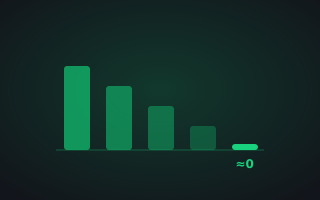
Automation drives the cost of delivery toward zero, so every job you complete keeps more margin.
See it work
Three self-contained views of Fulfillment: how it works, the outcome it moves, and the profit lever it pulls.
What Fulfillment gets you
Every one of these is a real outcome the engine helps a buyer reach — not a feature list.
Deliver exactly what you sold.
↑ reliabilityDrive the cost to deliver toward zero.
↓ costMake sure nothing falls through.
↑ riskHandle more work without hiring.
↓ timeProve the work was done right.
↑ reliabilityAutomate the repetitive delivery work.
↓ costKeep more margin on every job.
↓ costClose a job with books and work agreeing.
↑ reliabilityOrchestrate the whole delivery in one place.
↑ speedEscalate a problem before it costs you.
↑ riskComplete and verify without chasing people.
↓ timeTurn delivery into your margin lever.
↓ cost

Grounded in

A promise kept late is a promise broken.
Manual coordination adds cost to every job and margin disappears one dropped step at a time. Automating the repetitive work is what drives that cost toward zero.
Manual coordination adds a cost to every hand-off, and margin disappears one dropped step at a time.
Automation removes the repetitive step at each checkpoint, from orchestration to verification.
Unit cost falls toward zero, and every job you complete keeps more of what you sold it for.
Fulfillment runs the value stream once a sale closes, across eight sub-solutions: Orchestration and Coordination assign and sequence the work, Automation removes the repetitive steps, Reconciliation and Verification prove it was done, Distribution, Escalation, and Completion close it out. Automation is the lever that matters most here, because every step it removes drives the unit cost of delivery toward zero — margin recovered, not revenue chased.
- 1 Orchestration, Coordination, and Automation run the work
- 2 Reconciliation and Verification prove it was done
- 3 Distribution, Escalation, and Completion close it out
- 4 Moves the value stream and the margin